

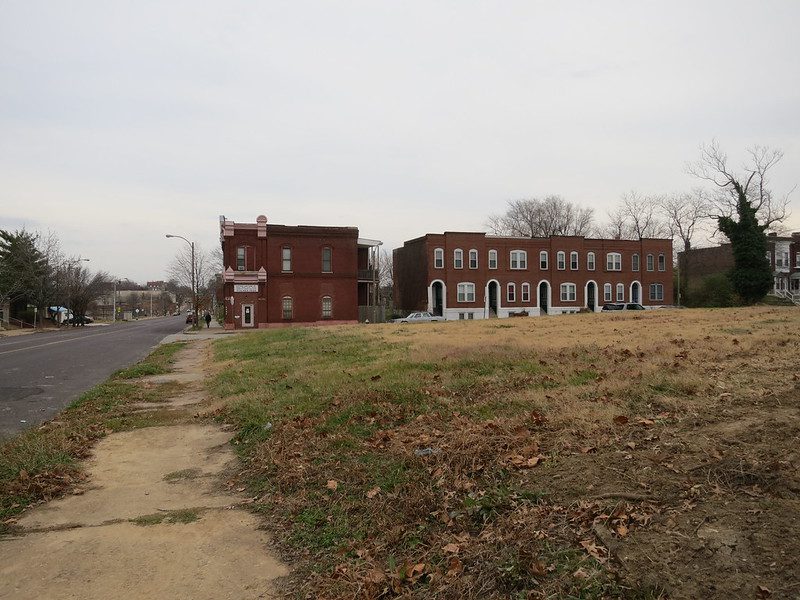
Photo by Flickr user Paul Sableman, CC BY 2.0
Using an ancient common law right of self-help nuisance abatement, one neighborhood was able to board up vacant houses and evict the drug dealers.
What do you do when drug dealers take over a vacant house in your neighborhood? When code enforcement, police action, and pressure on landlords all fall short, there is still an option – self-help.
Vacant, abandoned houses are magnets for the drug trade. Many neighborhoods are all too familiar with the “Field of Nightmares” maxim: “If you abandon it, they will come.” For dealers, the vacant house provides a useful stash place; for users, a convenient place to cook and use drugs.
For neighbors, it can create a living hell. Groups of dealers and users take over corners and open spaces. The concentration of drug addicts trying to support a habit generates increased petty crime. A constant threat looms of random violence associated with drug dealing. For those living near the vacant property, the dangers are even more tangible: there is a far greater risk that the vacant house will burn down as drug users set small fires to prepare drugs. Accumulations of trash, food, and human waste encourage rats and other vermin.
In the spring of 1993, the Butcher’s Hill community of Baltimore City was experiencing precisely this problem. Butcher’s Hill is a neighborhood of three-story brick row homes that were once home to the city’s prosperous butchers. After a period of deterioration under absentee landlords, some of the homes were rehabbed in the 1980s, and the neighborhood now contains a wide mixture of incomes and professions.
A vacant house, abandoned by an absentee landlord, attracted a trickle, then a steady stream of drug users and dealers. Traffic in and out was constant and heavy. “Day and night, they were out there, and acting as if the block belonged to them,” says Pastor Robert Dodson, whose East Baltimore Church of God sits next door to the vacant house. “They got so bold that a group of them sitting on the front steps asked me what business I had standing in front of my own church.” The church suffered a rash of thefts and attempted thefts in the rear of its property, an area that could only be accessed through the vacant house. Groups of dealers and buyers stood on the corners and interfered with residents on their way to and from their homes. The house suffered a major fire that heavily damaged the first floor.
Neighbors Organize
The Butcher’s Hill community association was determined to do something about their problem. First, residents began to collect information.
“We began to observe very closely what the buyers and dealers were doing and where they were going. We quickly realized that two vacant houses were the base of operations for dealers and a handy spot for the buyers to go prepare their drugs. We kept written logs of what we saw and who saw it,” said resident Carolyn Boitnott, who lived five houses away from the property. “To monitor the activity in the rear area of the property, which we could not see, I used to close the gate to the back yards of these vacant properties every morning, and by noon it would be open – every day, without fail.”
Then began a frustrating search for a quick, effective solution. Armed with their observation, residents contacted the police. Already familiar with the property, police confirmed that it was a shooting gallery and a base for a low-level street drug dealing operation and occasional prostitution. Yet, practically, the police could do little to stop it. As long as the property remained open for use, arrests would have no impact. Patrol officers could never invest enough time to keep dealers and users out of the building.

Next, Butcher’s Hill leaders contacted the city’s housing department. According to the city’s building code, vacant houses should be rehabilitated or torn down. Pending renovation, all openings must be secure against easy access. The code also allows the department to board up a vacant house and place a lien on the property. The vacant house in Butcher’s Hill already had numerous violation notices.
While housing officials were sympathetic, the Butcher’s Hill problem was symptomatic of a citywide epidemic. City officials were confronting an increased number of vacant houses with a vastly diminished staff of inspectors and boarding crews. They informed the Butcher’s Hill residents that it might take four to six months before they could send out a crew. There were other problems with having the city board the houses: with a heavy work load, city crews were rarely able to take much time to customize and reinforce the boarding. In addition, once the city crew boarded the house, if the boards were torn down, it could take another four to six months to replace them.
Meanwhile, the problem on the 2000 block of Baltimore Street was getting worse.
Butcher’s Hill community leaders then contacted the nonprofit Community Law Center, an organization that provides free legal services to community associations in Baltimore. The Law Center knew that vacant houses were a key topic of concern for community groups across the city.
“In the long term, communities want these houses fixed up or removed, and much of our work focuses on acquiring these vacants for community-based nonprofits,” said Anne Blumenberg, executive director.
The center was looking for a quick, cheap, effective way to allow community residents to stop the nuisance caused by these open vacant houses. The code enforcement process often took too long and left community groups feeling frustrated and powerless.
Old Law, New Problems
Long before there were codes and housing officials, how did people deal with intolerable nuisances? The answer lies in the ancient common law right of self-help nuisance abatement.
An extensive history of common law cases says that in some circumstances, people “damaged” by a nuisance can fix (“abate”) it themselves. The legal system is generally very wary of self-help, and self-help nuisance abatement is not appropriate for all types of nuisances. Typically, the common law rule involves nuisances that affect the health and safety of a person or “annoys or obstructs the daily convenience and use of such private property that cannot wait the slow process of ordinary forms of justice.”
In such situations, people damaged by a nuisance are not totally without recourse. They are entitled to abate nuisances themselves if they can show that:
-
- The nuisance harms them
- They have taken reasonable steps to notify the owner of the property of the existence of the nuisance before undertaking self-help abatement
- The self-help measures that they take are reasonable and do not disturb the peace. In addition, Plaintiffs can also recover “reasonable” costs of abating the nuisance from the owner of the property.
This rule arose in England during the late Middle Ages. By 1783, the great English legal scholar Blackstone observed, “a nuisance may be abated, that is, taken away or removed, by the party aggrieved thereby, as he commits no riot in the doing of it.” In the United States, a wide range of cases from across the country establish the same principle. The doctrine applies in every common law jurisdiction; in many areas it has been codified. A few examples provide a sense of how it has been used:
- An Oklahoma cattle rancher, whose thoroughbred herd was being impregnated by an unregistered bull that was illegally roaming the open range, took self-help action to stop the nuisance by castrating the bull.
- A city sewer was releasing noxious fumes on a man’s property. When the city refused to act despite repeated requests, he repaired the sewer and charged the city for the expenses he incurred.
- A rail company that asked a neighboring property owner to remove overhanging tree branches was entitled to abate the nuisance on their own when the owner did not.
- A retired couple had demanded the removal of a telephone pole erected in the alley behind their house without their permission. When the company failed to act, the couple sent a letter requesting the pole’s immediate removal and informing the company that they intended to cut the pole down themselves if the company did not. A week later, they hired an electrician to disconnect the wires and then cut the pole down.
[RELATED ARTICLE: Organized Tenants Are Baaaaack]
Butcher’s Hill Takes Action
Using this legal theory, Butcher’s Hill residents picked a date for boarding the vacant property and delivered a letter to the owner, giving him two weeks notice that they intended to board the property and secure it against drug dealers and vagrants. The owner was unresponsive. On the chosen Saturday morning, a group of 10 neighbors – including several local carpenters and masons – went to work. They installed frames of two-by-fours in the window openings, to which they attached extra-thick plywood. They blocked up the opening to the basement with cement. They boarded and wired the back garden gate shut. In all, it took about five hours and $150 of materials.
The residents then went to court to cover their total costs of $340.15 in labor and materials. They filed their case in small claims court, which is both the fastest and most informal Maryland court. At the trial, for which the owner did not appear, the plaintiffs offered testimony of police officers, neighbors, and housing inspectors to establish that the steps that they had taken to abate the nuisance were reasonable. An initially skeptical judge was convinced to ruled in their favor.
On the heels of this victory, Butcher’s Hill residents contacted the owner of another vacant house on the same block. Although previous discussion had been fruitless, this time he boarded the property the next day.
Now the Butcher’s Hill community is working to acquire and rehabilitate the vacant houses. While they pursue this goal, the former drug house is sealed and silent, and the drug transactions on the block are few and far between.
About the Author




Comments