| |
Issue #151, Fall 2007 |
Keeping Kukui GardensFaced with the prospect of losing their homes, residents of a Honolulu affordable-housing complex defied Hawaiian cultural traditions, getting organized and vocal and achieving a victory for affordability in one of the country's most expensive cities.By Kari Lydersen
|
For more than three decades, Carol Anzai and Rosella
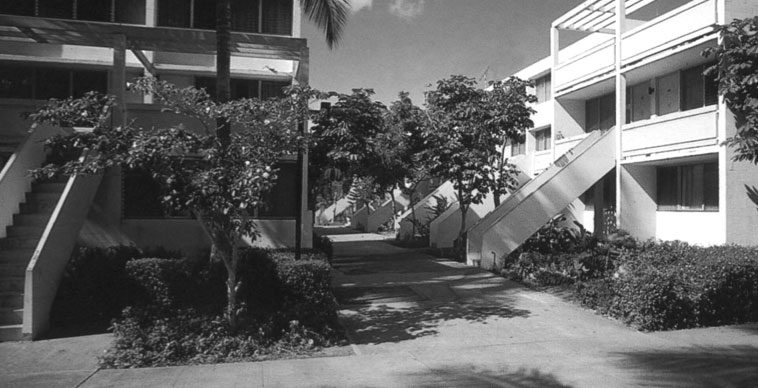
Newell have called Kukui Gardens home. An 857-unit affordable-housing
complex on the edge of Honolulu's Chinatown, it is a place where 2,500
residents - many of them senior citizens - look out for each other,
taking walks in the local park and fishing in the nearby river. In a
city known for upscale tourism and luxury vacation homes, such affordable
housing for senior citizens and working families is increasingly rare
- one resident calls the development "a blessing." So residents were terrified when they heard that
Kukui Gardens, built in 1970 by a nonprofit foundation, might be sold
and transformed into market-rate housing. What resulted was a multi-faceted
campaign in which residents, interfaith leaders, national housing advocates,
and local politicians gained what - if everything comes together as
planned - is a historic affordable-housing victory. Kukui Gardens was one of hundreds of affordable-housing
projects built in the 1960s and 1970s under a federal program created
by the 1937 National Housing Act in which the U.S. Department of Housing
and Urban Development (HUD) would subsidize building costs, provide
a low-interest loan, and insure a mortgage for private developers constructing
affordable housing. The mortgage terms mandate the developments stay
affordable for 40 years, allow rent increases only to cover operating
costs, and require regular inspections, specific tenants' rights, and
other provisions. "It was built mostly as a reaction to [failed]
public housing," said Drew Astolfi, a lead organizer with the Honolulu
interfaith group FACE (Faith Action for Community Equity) who cut his
teeth fighting to preserve HUD-subsidized affordable-housing projects
in Massachusetts and Chicago in the 1990s. "It's the nicest subsidized
housing there is. If we could do this now we wouldn't have a housing
crisis in America." Over the past two decades, as property has gotten
more valuable in many of the areas where HUD-subsidized affordable projects
were built, owners have sought to turn the projects into market-rate
housing by prepaying their mortgages and releasing themselves from the
HUD restrictions. A 1983 amendment to federal fair-housing law says
that at many projects including Kukui Gardens, where the original charter
granted HUD approval rights over prepayment, this can only be done if
several conditions are met. Those are that the project no longer meets
a need for affordable rental housing; that residents are notified of
the prepayment plan and allowed to comment on it; and that displaced
residents are given relocation assistance. In January 2006, it became known that Kukui Gardens
Corp., the nonprofit company that runs the development, was seeking
to prepay the $2 million balance remaining on its $16.1 million HUD-insured
mortgage and sell the development for about $130 million to the San
Francisco-based Carmel Partners development company. (These details
were later confirmed in announcements by Kukui Gardens Corp. and Carmel
Partners). "People were very upset and worried because
there would be no place for them to go," said Anzai, 58, who raised
four kids at Kukui Gardens and now lives there with her husband, who
was in the military. "I can't imagine my life not living here in
Kukui Gardens." The Kukui Gardens Corp. said the mortgage prepayment
was necessary to obtain funding for needed repairs. Once the mortgage
was prepaid, they would be freed from HUD restrictions and allowed to
sell the development. Then profits from the sale would go to the Clarence
T.C. Ching Foundation, the nonprofit organization that formed Kukui
Gardens Corp. and also runs several Catholic institutions: the Saint
Louis School, Chaminade University, and the Saint Francis Healthcare
Foundation. Carmel Partners associate Chris Beda says the development
would still have remained affordable, in compliance with HUD restrictions,
through 2011. And he said the company was willing to maintain affordable
housing in the long term if tax breaks and subsidies could be leveraged,
but none materialized. "Everyone is in favor of affordable housing
until money has to be allocated for it," he said, adding that,
"people don't realize for-profit companies can be the most efficient
at managing affordable housing with tax exemptions and subsidies." Locals speculate the Kukui Gardens sale was orchestrated
to bail out the foundation from recent financial troubles. The foundation's
2006 tax filings showed that it lost more than $630,000 - about one-fifth
of its assets - in a poorly performing Morgan Stanley junk-bond issue
overseen by a Morgan Stanley employee who is the son of a former Ching
Foundation trustee. This spring the Hawaii attorney general's office
began investigating complaints of conflict of interest in the foundation's
investing. And Wallace Ching, the only Kukui Gardens Corp.
board member who opposed the Kukui Gardens sale, was voted off the board
after questioning its financial accounting and management. In August
2006, he sued the company and its board, alleging the foundation mismanaged
assets and didn't provide him with details of the sale. When Anzai heard about the proposed sale, she called
Rod Tam, a city councilman who had previously represented the area as
state senator and helped defeat a proposed rent increase at Kukui Gardens.
Tam, a well-known firebrand, was incensed at the news. "I contacted Carmel Partners and told them
openly they're not welcome here in Hawaii," he said. "I called
them carpetbaggers. They didn't like that. It was a matter of telling
them we will fight you. Once things started happening, they realized
they had to deal with the residents." Tam contacted FACE, which works on housing, jobs,
and other economic and community-justice issues. The stakes were clearly
high: Kukui Gardens is the state's largest HUD-insured affordable-housing
project, and one of the larger ones nationwide. With such a severe shortage
of affordable housing, the transformation of Kukui Gardens into market-rate
housing could mean homelessness or drastic upheavals for many of the
residents, who pay on average $444 to $818 a month for one- to four-bedroom
units. Market rates are exponentially higher. HUD data show that more than 50,000 renter households
in the city are paying more than they can afford or living in overcrowded
units. A 2003 Hawaii housing policy study commissioned by state and
local agencies showed "very low or no" production of new rental
units, causing "low-income households to be squeezed out of the
market altogether." "It seems like everything is being built for
luxury and people with a lot of money," said Newell, 82, who raised
four kids as a single mother at the complex. "People just come
for a few months and don't even live here. But where are the local people
going to live? That's why we have so many people living on the beach,
all these working homeless who are working but still can't afford a
place to live. I don't know what I would have done (if the sale went
through), I don't want to be a burden on my children, but it might have
come to that." Anzai rallied residents to fight for their homes,
and FACE organizers launched a campaign that brought together local
and state politicians, clergy, and national fair-housing experts. They
formed alliances with groups and individuals who were coalescing to
fight sweeps of homeless people on beaches and parks. In March 2006
after city officials evicted almost 200 homeless people from Ala Moana
Beach Park, protesters marched to City Hall and camped out there. "A lot of sympathy developed around that because
there were working families with kids who were becoming homeless,"
said the Reverend Bob Nakata, a former state representative (1982-1986)
and state senator (1998-2002) and pastor of the Kahaluu United Methodist
Church on the windward side of the island. "Where previously there
was the attitude of get the homeless out of our communities, now there
was a much more positive attitude. With Kukui, the connection was made
quickly, that affordable housing had to be preserved. There was a lot
of dovetailing between the homeless advocacy movement and Kukui Gardens." Hawaii Governor Linda Lingle called the prepayment
plan illegal and spearheaded the passage of legislation in July 2006
allowing the state to use eminent domain to prevent the sale. However,
in order to invoke eminent domain, the state would have needed to condemn
the property. Lingle said she would take that measure only as a last
resort, if efforts to turn the project over to a nonprofit developer
failed. As it turned out, Lingle didn't need to invoke eminent domain
to save the affordable development. But FACE organizers say her support
and willingness to intervene was invaluable. In October 2006 the Kukui Gardens tenants' association
and FACE filed a lawsuit in U.S. district court in Hawaii charging the
planned sale would violate the National Housing Act provisions regulating
HUD mortgage prepayments. The suit also argued that the sale would constitute
discrimination against non-white tenants, because they are about 1.5
times more likely to lack affordable-housing access than white tenants.
Federal law mandates nonprofit groups be given a "reasonable"
chance to acquire HUD-subsidized developments put up for sale. Four
nonprofits originally expressed interest in purchasing the development;
the lawsuit charges Kukui Gardens Corp. did not fairly consider their
offers before negotiating with a for-profit developer. "The issue of HUD permitting owners to pre-pay
the mortgage when they don't have to has come up repeatedly, and HUD
has for years taken a position that is contrary to plain language"
of federal housing law, said Jack Cann, attorney for the San Francisco-based
Housing Preservation Project, which
represented FACE and the tenants in the lawsuit. "So anyone who
wants to sue HUD has pretty good grounds to do so." Meanwhile, organizers and residents knew community
pressure and public opinion would be essential to their struggle. Using
an approach that interfaith groups nationwide have applied to workplace
struggles, FACE enlisted local clergy to talk to Kukui Gardens Corp.
board members and other stakeholders. This was especially appropriate
given that the Ching Foundation is a faith-based Catholic organization. FACE organized pickets and demonstrations and took
residents and clergy to visit City Hall and the offices of Kukui Gardens
Corp. and Carmel Partners. They interrupted a Kukui Gardens Corp. board
meeting. At an "Accountability Assembly" in March 2007, 850
people rallied in a cathedral demanding local elected officials do their
part to save affordable housing. "FACE's style of organizing is somewhat more
assertive than Hawaii is used to," said Nakata. "It was like
a reintroduction of the tactics of the heyday of the labor movement.
A lot of that was carried by the tenant organizing. They were loyal,
30 to 50 people could be counted on to turn out at all the rallies and
demonstrations." Most residents - many of them senior citizens of
Chinese or other Asian ethnicity - had never participated in community
organizing or activism. "We're new to this," said Anzai. "We
had rallies, demonstrations, sign-waving, going to the capital, to the
offices of the developers and the sellers. We were all nervous, totally.
We'd never done anything like this before. Hawaiian people just don't
go out in public, especially Asian people; we are really conservative
and shy. I'm not one to go out and hold up signs. But we had to do it,
so we did it." After about 14 months of campaigning, in the spring
of 2007, an unofficial agreement was reached which residents and organizers
see as a big victory. As this issue of Shelterforce went to press
the final details of a settlement, which will essentially split Kukui
Gardens in half, were being ironed out. The state will buy half of the 22-acre development
and turn it over to a nonprofit development company that will maintain
it as affordable housing for at least 55 years. Carmel Partners will
be able to develop the other half as office, retail, and restricted-income
housing - meaning tenants can make no more than a designated percent
of the state's median income. Beda declined to give exact details of
the income restrictions, but said it would include units for people
making 80 percent of state median income for a certain amount of time;
and later on the limit would be raised to 140 percent of median income.
While this arrangement doesn't put a ceiling on the rent Carmel can
charge, Beda characterizes it as "affordable." "The rents might need to be artificially lowered
to fill the units with that restriction," he said. And if things go as planned, low-income tenants
currently living in Carmel's part of the property will be relocated
into new units which will be built on the affordable half of the property. The settlement was negotiated in large part by
the development firm Devine & Gong and their development consultant,
Chan U Lee, a Hawaii native who grew up across the street from Kukui
Gardens and worked pro bono for a year and a half with FACE and the
residents. "We couldn't have done it without them," said Astolfi. The affordable half of the development, which is
estimated to cost about $80 million in rehabilitation, new construction,
and rent-subsidy costs, will be financed through state funds and federal
tax incentives. Half of those units will be allocated for residents
making less than 30 percent of the state's median household income,
and the other half for those making less than 60 percent of median household
income. That means $11,000 to $29,000 a year; and $22,000 to $58,000
a year, respectively, depending on family size. Current Kukui Gardens
residents who don't meet those income ceilings will be allowed to stay
until 2011. "Implementing the settlement will involve
lots of people moving within the project," said Cann. "It's
a less than perfect resolution, but on the other hand the federal mortgage
would be completely paid off in 2011 and then nobody would have any
leverage at all. So the fact that they tried to sell it before 2011
in a way that violated federal regulations was propitious. It gave the
residents a chance to step in and force negotiations." In the next four years, HUD-insured mortgages will
expire on at least 394 projects with more than 40,000 units nationally,
according to Cann. Organizers hope that the Kukui Gardens victory can
provide lessons for housing groups nationwide fighting both HUD mortgage
pre-payment efforts and fighting to keep projects affordable once HUD-insured
mortgages expire. And in Honolulu, the fight for affordable housing
is far from over. Even as the Kukui Gardens victory was falling into
place, in February 2007 Honolulu Mayor Mufi Hannemann announced he wanted
to sell 12 affordable-housing projects owned by the city, claiming they
are too costly to maintain and manage. The mayor said buyers would be
obligated to keep the projects affordable, but residents and housing
activists are skeptical. Nakata thinks the success of Kukui Gardens residents
will help protect affordable housing at the city developments. "For
the future in housing, this has had a very positive impact," he
said. "This will be a major part of the solution to the housing
problem here. The government and key House and Senate leaders came around
to being very supportive, and we helped make housing and the homeless
one of the top issues in the state." "This is a lesson for people who come to Hawaii
and try to invest," added Tam. "Hawaiian people are soft-spoken
generally, but don't get us upset!" "This has made people more confident and stronger," confirmed Anzai. "We thought we could never do what we did. Now we know we have that power. It's people power, that's what it is." Copyright 2007 Kari Lydersen is a staff writer at The Washington Post out of the Midwest bureau and author of Out of the Sea and Into the Fire: Latin American-U.S. Immigration in the Global Age. www.karilydersen.com.
|
|
|
|