

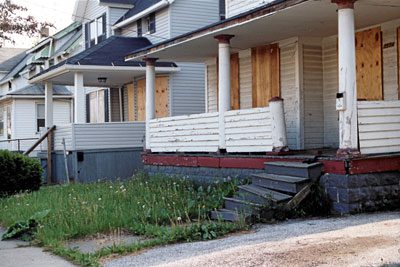
These days, it is hard for Ed Kramer, a fair-housing attorney in Cleveland, to drive around any city neighborhood or suburb without seeing boarded-up houses interspersed with well-kept, occupied homes. For Kramer, the blinkered windows are telltale signs of a foreclosed home whose owner may have fallen prey to subprime lending. In 2006, there were 14,200 foreclosure filings in Cuyahoga County, and a 21-percent increase is projected for 2007. These figures are the worst Kramer has seen in his 32 years of practice.
Every month, Kramer, founding partner of Housing Advocates Inc. (HAI) in Cleveland, one of the grass-roots advocacy groups on the forefront of aiding Ohio homeowners facing foreclosure, holds a round robin with local lenders committed to fair lending practices and helping homeowners through refinancing. One by one, Kramer goes over each homeowner’s dire case and the terms of the current mortgage. By his count, most of the delinquent mortgages were approved by subprime lenders, and their ballooning monthly payments have caused the borrowers to fall behind. The lenders’ representatives would decide whether their respective financial institution would agree to refinance the mortgage, mostly based on the size of the current mortgage and equity in the property. In a single afternoon, the group can go through several cases.
“For every home owner we save, we’re losing 19 others,” says Kramer.
Judging from the magnitude of Ohio’s foreclosure crisis, Kramer, whose three decades in housing-justice practice may have added some white to his well-trimmed beard, can seem like the Dutch boy who used his finger to try to plug a broken dam. Foreclosure filings statewide have been rising steadily since 1996 – from 18,818 to 79,072 in 2006, according to summary reports compiled by the Supreme Court of Ohio. That’s a 300-percent jump over a decade, and the number of filings hasn’t even peaked yet.
In the fourth quarter of 2006, more than 5 percent of all mortgages originated in the state – the second-highest percentage nationally – were delinquent, as reported by the Mortgage Bankers Association’s National Delinquency Survey. An estimated 150,000 to 200,000 adjustable-rate mortgages in the state are set to increase their interest rates in 2007 and 2008, according to “Dimensions of Ohio’s Foreclosure Crisis,” a March 2007 report co-authored by Bill Faith, executive director of the Coalition on Homelessness and Housing in Ohio (COHHIO). If history is any guide, one in three of these mortgages is destined for delinquency.
While other grass-roots advocacy groups in Ohio, like Kramer’s, acknowledge the massive nature of the state’s foreclosure problem, they see no substitute for individualized attention in order to achieve a lasting resolution for homeowners in danger of losing their homes. The advocates aim not only to help fend off foreclosure but also to restore financial stability for every homeowner they help. The two-pronged strategy that most of these groups are employing – education and negotiation – takes time and finesse. But it’s succeeded in keeping people in their homes, many of these advocates say.
Although “this is a home preservation project,” says Jim McCarthy, executive director of the nonprofit Miami Valley Fair Housing Center in Dayton, “you really are talking about case-management services. We have to have a comprehensive approach.” McCarthy says it’s important to follow through with homeowners in order to address the root causes of their financial problems, instead of just putting out the foreclosure fire.
At McCarthy’s agency, the process of receiving help with foreclosure begins with a 21-page questionnaire. The detailed document is designed to capture the full picture of homeowners’ credit history and financial health and traces their steps leading to their descent into the subprime loan trap. All this information, McCarthy says, goes a long way to helping his staff in negotiating a sustainable settlement – one that keeps homeowners in their house with affordable monthly payments based on their income. For this service, the homeowners are required to pay a nominal fee of $48 and attend a six-hour financial-fitness class.
The agency has been overwhelmed with requests for help. As many as 6,600 homes in Montgomery County are projected to be foreclosed on this year – that’s a quarter of all homes in the service area. McCarthy says the questionnaire and the nominal fee help to weed out clients who lack the commitment to work with his staff through the process – which sometimes may turn into a war of wills with lenders who initially refused to compromise.
It doesn’t always come to that. “We try to appeal to [the lenders’] sense of reason and business sense to keep this borrower in the home,” says McCarthy. With unrelenting lenders, the agency promises to drag out the process to make it “the lengthiest, costliest foreclosure” ever.
Often, McCarthy’s staff attorney and two paralegals dedicated to the foreclosure cases find recourse in the courts. “When we find good legal violation [by the lender], we file a lawsuit. We’ll try to bring litigation to protect the borrowers.”
McCarthy estimated over the past four years his agency helped 230 people keep their homes; most clients average two years of services. Still, 117 cases remain in negotiation.
Negotiation is a big part of the game, say both public-interest attorneys and other housing advocates aiding homeowners. Many of the homeowners facing foreclosure were lured into mortgage products with low teaser rates and are now slapped with payments rising as frequently as every six months. Some homeowners are forced to make monthly payments that consume half or more of their income, far exceeding the federal affordability guideline of paying no more than 30 percent of household income toward housing costs. Short of restructuring their mortgage to an affordable, fixed-rate loan, no amount of aid can afford homeowners a lasting relief from the fear of foreclosure.
Refinancing these subprime mortgages invariably involves putting in money to fill the gap between the outstanding loan amount and the current appraised value of the property. Because some sub-prime lenders are in cahoots with unethical appraisers known to inflate the appraised value of a property, homeowners end up borrowing more than what their house is worth. This is where government money comes to the rescue. And to hear advocates tell it, these are hard-earned dollars.
“We have been pounding the table, nudging the Ohio Housing Finance Agency more than a year. They’ve never done a refi before,” says COHHIO’s Faith. But pressed by Faith and other advocates about the urgency of the foreclosure crisis, the state housing finance agency this spring started a conventional refinance program to serve households making up to 125 percent of the area median income, or around $72,000. This bond-backed program is expected to grow to $500 million by year-end and to refinance 5,000 homes. Nationally, Ohio’s housing finance agency is among the first to offer refinancing.
Meanwhile, Fannie Mae has set aside a total of $5 million for high-foreclosure states, such as Ohio, for its Help Eliminate Loans that are Predatory program that will fund up to 97 percent of the appraised value of the property. The three-percent or more gap (some homes may have negative equity) is filled by money from the Ohio Department of Development under its Emergency Mortgage Assistance Program. Homeowners needing this extra help will receive a second mortgage, instead of a grant.
Even when backed by such financial resources, homeowners and their advocates often find it difficult to negotiate with predatory lenders. Just as they were evasive about the true costs when they originated the loan, these lenders are less than forthcoming about how much homeowners really owe when they seek to refinance the mortgage. “[The lenders] are not being forthright with the payoff. They would hem and haw,” says Lois McCampbell of The Samaritan Project, a nonprofit housing counseling arm of Tabernacle Baptist Church in Columbus. “They try to get as much from the deal as possible.”
And when the lenders come forth with a figure, they often pile prepayment penalties, attorney fees, and a whole host of other charges on top of the original loan.
To beat the lenders at their game, McCampbell’s organization partners with responsible bankers who are willing to help homeowners negotiate for a refinance. Lender-to-lender negotiations tend to go more smoothly because, McCampbell says, “They know the terminology; they know the margin.”
Adding to the complexity of the negotiation process is how the mortgage may have evolved after the loan papers were signed. In order to free up their capital, lenders often bundle the home mortgages and sell them as securities to investors or financial institutions. An intermediary, such as a loan servicer, will continue to enforce the terms of the loan and pursue foreclosure as it becomes delinquent – but may not have the authority to renegotiate the loans they service. The current holder of the loans may claim ignorance of the lender’s malpractice and see no obligation to forgive the borrower.
Mary Wakeel’s foreclosure case illustrates how quickly a bad loan could cripple the borrower and how limited the recourse for intervention can be.
The 78-year-old retired seamstress and her husband bought a three-bedroom bungalow on University Circle in Cleveland 20 years ago. Now divorced, Wakeel enjoys sitting on her screened porch and taking in the vitality of this college neighborhood near Case Western Reserve University and the Cleveland Museum of Art. In 2001, she obtained a refinance loan to pay for some repairs.
“I got a loan to put a new roof on, get new windows, and put new flooring on,” says Wakeel. “I specifically asked them for a fixed-rate loan; I didn’t want variable rates.”
Unbeknownst to Wakeel, the lender approved an adjustable-rate loan, and the $95,000 loan carried a starting payment of $833-about 40 percent of Wakeel’s income at the time. The lender also promised her $6,000 in cash for her disposal.
When she retired, in 2004, the monthly payment crept up to $900, slightly larger than her Social Security check, her only source of income. That was when she began to fall behind.
“I just couldn’t keep up with it. It just kept getting worse,” says Wakeel. “I had to go to apply for food stamps.”
By now, her payment has soared to $1,200, and her house has been in foreclosure since June 2006. Wakeel was referred to Kramer’s law firm by a housing counselor six months later. Staff attorney Gretchen Bowman found the only legal leverage to stall the foreclosure proceedings – to sue the bank under the federal Truth in Lending Act. The lawsuit claims that the bank violated the federal law because Wakeel never received the $6,000. Bowman hopes that legal action will bring the bank’s counsel to the negotiating table to work out an affordable fixed-rate loan.
There are many others who are in Wakeel’s boat. Housing advocates lament that there are only so many they can help without stretching themselves too thin to serve anyone adequately.
“If we’re going to have a real impact, we’ve got to do a much wider action to stop this. We want to attack this on the industry basis,” says Kramer.
And Kramer has just fired the first salvo. In April, HAI filed a fair-housing complaint with the U.S. Department of Housing and Urban Development charging Argent Mortgage Company, Wells Fargo Bank, and First National Mortgage Company with discriminatory practices because the subprime mortgages they’re handling are concentrated in Cleveland’s predominantly African-American neighborhoods, such as the East Side. Argent, formerly a division of Ameriquest, sold the most mortgages in Cleveland in 2004.
Meanwhile, a local grass-roots group in Cleveland, known as the East Side Organizing Project (ESOP), has since 1999 been rallying hundreds of residents saddled with subprime financing. The group recently has expanded its organizing beyond the neighborhood to northeast Ohio. Through door-knocking, leafleting, and holding meetings, ESOP works to build a critical mass of aggrieved borrowers who have suffered from the practices of a particularly notorious lender. Each borrower fills out a “hot spot” card, detailing the problems with his or her loan. Armed with the documented grievances, ESOP organizers ask to meet with the lender’s management to negotiate a collective agreement.
Instead of pushing legal papers, the group resorts to heckling and public shaming to break these lenders’ resistance to negotiation. Over the past two years, as many as 10 lenders signed an agreement with ESOP promising to reach a suitable workout with their borrowers and follow the fair-lending practice in making future loans, says Jenelle Dame, an ESOP community organizer. The group is now gearing up to take on an industry Goliath: Countrywide Home Loan in California.
Given that loans originated in Ohio are approved by lenders across the country, Ohio’s advocates say they need to see federal intervention – sooner rather than later. There is a limit to how much change grass-roots efforts can accomplish, they admit.
“We can’t change the IRS code. We cannot change the securitization contracts. We can’t solve all these problems as a state,” says Faith. “We need the federal government to step in to help. We’re getting little help from our regulators in Washington, D.C.”
While the struggle over marshalling financial and legal resources to bail out homeowners continues, foreclosure filings in Ohio show little sign of subsiding. The state’s emergency-assistance and refinancing programs have saved some homes, but there are many more at risk.
Advocates statewide are convinced that without drastic federal intervention the crisis will not ease, but they hope that through homeowner education and outreach, fewer people will fall for predatory-lending schemes. Yet, however tirelessly they work to keep homeowners’ heads above water, advocates cannot make up for the fact that most predatory lenders continue to operate outside of federal oversight. With the threat of adjustable-rate mortgage products sold during the past few years still on the horizon, advocates are bracing for the next wave and preparing to answer more cries for help.
About the Author


Comments