

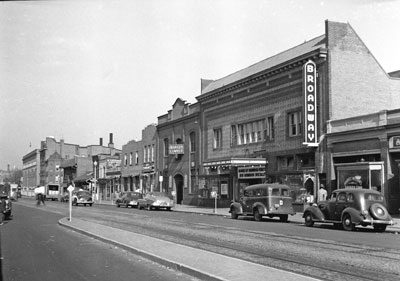
The neighborhood just south of U Street in Northwest Washington, D.C., is abuzz with industry on any given day of the week. Sturdy little row houses that have withstood decades of neglect are being renovated into micro-mansions. Off comes the preternaturally well-preserved Astroturf that once covered front porches and steps, and out go olive green appliances and shag carpeting; in come new bay windows, bamboo floors, and granite counter tops.
For all of the retail and office space planned for 7th Street between U Street and Rhode Island Avenue, very little dirt has actually been moved so far. But this hasn’t kept residential real-estate prices in the area from skyrocketing. After all, this neighborhood sits between Chinatown/Penn Quarter (the newly booming downtown hotspot) and the U Street Corridor (the once-again booming, former Black Broadway of D.C.).
Residents of the neighborhood, once simply known as “mid-city” but renamed “Shaw” in 1966, are bracing for major gentrification. Pick up a newspaper and you may find headlines like “Shaw Residents Fear ‘Renewal’ Will Become ‘Removal’,” “Renewal Amid Shaw Area Chic,” “At Core of City, Old-Timers, Recent Arrivals Seek a New Balance,” and “A Bittersweet Renaissance.” But Shaw residents have been bracing for a long time now. Those headlines appeared in the Washington Post and Evening Star newspapers in 1968, 1978, 2003, and 2006, respectively.
Shaw has always been emblematic of blacks’ struggle to contend with racial prejudice and social inequity. In its glory days in the 1920s and 1930s, Shaw was the de-facto epicenter of black intellectual and cultural life in segregated Washington, D.C. A post-integration decline of the early 1960s was punctuated by the 1968 riots and decades of failed redevelopment plans.
Now, 40 years later, the neighborhood is on the cusp of thriving again. A hot real-estate market and the savvy marketing of Shaw’s illustrious black history have made it a desirable address. For the first time in more than a century, large numbers of non-blacks, many of whom have more wealth and power than any prior residents, are moving into the neighborhood.
Against this backdrop, a Shaw community development corporation, One DC, seized the opportunity to create the city’s first community benefits agreement. Such an agreement is made between a coalition of community members and a for-profit developer or a quasi-private city entity to protect low-income residents from displacement and to include them in the neighborhood’s economic growth. Although new to D.C., community benefits agreements have been implemented in cities across the country since the concept was first developed in Los Angeles in 2001.
In a city where the government has been known to hand out substantial incentives to encourage development on even the choicest pieces of real estate, One DC’s equitable-development approach is quietly radical. It seems fitting that the Shaw neighborhood, a place literally scarred by the history of black oppression and exploitation, should be the region’s testing ground for this community tool that transforms ignored people and places into surprisingly powerful assets.
Segregated Mid-City and the Black Broadway Heyday
“Red to the rind, sweet like honey and cold and fine!” Joe Spears fondly recalls the call of the summertime watermelon vendor as he guided his colorful, horse-drawn cart through Shaw’s streets in the 1940s. Spears grew up at the intersection of 7th Street and Rhode Island Avenue. When he talks about the neighborhood he grew up in, he paints a picture of an urban Mayberry.
Although the community was comprised exclusively of black residents, mid-city was diverse in every other sense. This bustling neighborhood was home to Howard University, two hospitals, four theaters, and countless stores, restaurants, and nightclubs. Locals included Langston Hughes, Duke Ellington, and Charles Hamilton Houston, among other luminaries in the fields of art, music, law, and architecture.
Tania Jackson, a seventh-generation Washingtonian whose family has long roots in D.C.‘s inner-city neighborhoods, talks intimately about the changing life of the city as seen through her family’s stories. “The black community was a broad spectrum,” says Jackson. “You had very poor people and relatively well-off people living cheek to jowl.”
During segregation, many residents relocated to mid-city after being displaced from other neighborhoods. In the 1940s and 1950s, blacks were squeezed out of Georgetown when historic preservationists and city planners recast the neighborhood as a fashion and social center. Residents of the teeming southwest quadrant of the city were forced to flee when their neighborhoods were razed for an urban-renewal project. Many other black neighborhoods experienced a population loss when the government took claim to private properties for highway construction through eminent domain.
Despite the challenge of incorporating so many new residents, a sense of cohesion and community existed in mid-city. Sheila Miles, who grew up at 14th Street and W Street in the mid-1960s, recalls a neighborhood where everyone knew each other. She marvels that, as children, she and her friends could walk into any house on her block at lunchtime and whoever lived there would see to it that they had lunch. Saturdays meant dinner parties and card games with extended family and neighbors. Friday night fights aired each week from the Spears’ living room. Cost of admission: one pot-luck dish.
Shaw’s Decline
Joe Spears grew up in the same house in which his mother was born. After high school, he walked five blocks north up 7th Street to attend Howard University. The Spears family left Shaw in 1964. They moved about two miles northwest into a much larger house in what had previously been the whites-only Sixteenth Street Heights.
Explaining why so many middle-class blacks left Shaw after integration, Spears says, “Just imagine that that seal there [illustrating with an envelope] closes off something and all of a sudden you lift that seal and the doors open, and now you can see things that you didn’t see before. The Sixties opened up a lot of things for blacks. Blacks began moving into better jobs. We were janitors before. Now blacks were working at IBM, and the government was opening up.”
With new opportunities outside the neighborhood and an increase in local crime, mid-city was quickly becoming a place to leave, and most of those who could, did. Along with the departing middle class went its contribution to community cohesion, as well as the businesses it supported. There were signs that the steamroller of urban renewal would bear down on mid-city and flatten yet another low-income, black neighborhood. In 1966, the Planning Commission outlined a new neighborhood within mid-city and renamed it the Shaw School Urban Renewal Area. At the same time, civil rights took center stage at the national level, and each headline on police brutality, displacement, and inner-city abandonment fueled social unrest.
It was within this context of change that Martin Luther King, Jr., was assassinated on April 4, 1968. Within a few hours, mid-city residents gathered outside of many white-owned businesses to demand that they close in honor of King’s death. When the crowd became violent, the rest became history.
“It seems to be the touch point for a lot of people when they talk about the community, but,” Jackson says, “I don’t think that the riots necessarily define this area. A lot more happened both before and after the ’68 riots, but it is true that there wouldn’t be a need for revitalization if the riots hadn’t happened.”
Spears, summing up the difference between the neighborhood he remembers from his boyhood and what Shaw became, concludes, “It was a friendlier community then. It was a friendly time. The Shaw area went through its most dramatic change, of course, in 1968 when they burned everything out. It never recovered its closeness. There was just an underlying mean spirit.”
Miles and Spears run through a litany of stores and restaurants that closed and never reopened after the riots. The two businesses they recall surviving are Wings N Things on 14th Street and the liquor store at 1414 14th Street.
Rioters destroyed 135 businesses – many of them white-owned and long-time neighborhood fixtures – that never returned to Shaw or the inner city. For many residents and businesses already considering a move to where the economic power was relocating, the riots were the last straw. According to Spears, everyone left, and the resulting vacuum was filled by gangs, dealers, and pimps. Jackson recalls that in the late 1970s and early 1980s, “The U Street corridor was completely bombed-out looking. There was nothing. You really did see a neighborhood that was in trouble, and you did not see the same broad range of people. It really did look like an area that nobody cared about.”
The disturbance on Shaw’s main streets in the 1980s, caused by years of Metro subway construction and exacerbated by the heroin and crack epidemics, is blamed for the closure of 70 businesses in the area. A swell of new residents moved into Shaw in the early 1980s, hoping that revitalization would follow completion of the Metro. Instead, the newcomers endured the crime wave of the 1990s, and after fixing up their Victorian row houses, many left by the middle of the decade.
In 2001, the city launched a major development plan just south of Shaw in Chinatown/Penn Quarter. There were deep subsidies for private investment such as luxury condos, hotels, and businesses catering to visitors, all planned to accompany a new convention center. With investment creeping in from Chinatown/Penn Quarter on the south side of the neighborhood and resurgence along the U Street corridor to the north, the city launched the Duke Plan in 2005 specifically for Shaw.
Named after Duke Ellington, the proposed plan aims to attract new investment to Shaw by drawing from the area’s rich cultural history. The commodification of early 20th-century black culture, and the lure of prime, central-city property, is a sure sign that gentrification will find its way to 7th Street.
Community Benefits Agreement
In 2004, before any particular development was scheduled for their corner of Shaw, One DC and neighborhood residents consulted with the national groups PolicyLink and Good Jobs First, and worked with local churches, a family-support collaborative, and the United Planning Organization to devise a list of equitable-development principles. Realizing that rapid reinvestment was coming to 7th Street, One DC tried to position itself as a voice for equitable development. “The way that we look at the role of the community development corporation is to promote equitable development – developing people and place at the same time,” says David Haiman, One DC’s associate director, who led the community-benefits effort.
“There are ways that development, in the way that it is done, has disproportionately negative impacts on low-income people and people of color,” explains Haiman, “destroying their communities, moving them around, treating them like chess pieces. And the notion of equitable development in that context is a process of organizing community members to reshape the way development happens, and also to advance ‘best practices’ that will achieve equitable development – either through legislation or in the trenches. We advocate for a combination of the two.”
Vacant lots and abandoned buildings in Shaw, bought and sold without improvements for decades by land speculators, are “almost like a crime perpetrated against the people in the community,” says Haiman. “The notion that that can be allowed when there are clear negative impacts, like crime and drugs and rats and trash, on community residents … There’s some kind of economic stake that community members should have.”
Inspired by groups such as the Dudley Street Neighborhood Initiative in the Boston area, and in response to the city’s red-hot real-estate market, One DC changed how it viewed vacant land in Shaw. Rather than community burdens that developers must be coaxed into rebuilding, vacant parcels should be viewed as valuable assets – sheer potential waiting to be realized. “Maybe the steamroller hasn’t crushed as much as we had thought,” says Haiman, “and if we use these principles of equitable development, perhaps we could set the standards for future development.” By shifting from a defensive strategy to an active approach, One DC sought to bring out the community’s power as a driver of change, rather than as a victim.
One DC worked with residents and community leaders to develop principles that could be applied to city-sponsored redevelopment projects. Those principles became the basis for a list of equitable-development goals that included an affordable housing set-aside, living-wage jobs, a percentage of jobs for neighborhood residents, space for local businesses, and a community fund tied to the profits that any development would generate.
In 2004, with the list of equitable-development principles in hand, One DC approached the National Capital Revitalization Corporation, a semi-private corporation that the D.C. government created in 2001 to redevelop many of the city’s abandoned and vacant properties. The goal was to have the corporation adopt the equitable-development principles and include them among the criteria it uses in evaluating submissions of proposals to develop tracts of land under its supervision. After a year and a half of negotiations with One DC, the corporation declined to adopt the principles.
Just as One DC and its community partners were coming to terms with the rebuff, One DC learned that the corporation was negotiating with a private developer on plans for a valuable, undeveloped piece of property on 7th Street in Shaw. (Even if the corporation had adopted the equitable-development principles as judgment criteria for submissions to its public requests for proposals, they might not have been applied to this project, since it was a private deal, made without a public RFP.)
Within two days, One DC and its partners reformulated the equitable-development principles into a list of specific community benefits to be obtained from the pending 7th Street deal. They demanded that the corporation and the private developer sign a community-benefits agreement or face public protests at the project’s permit and zoning hearings. In March 2005, in response to the community pressure and seeing the opportunity for neighborhood support, the National Capital Revitalization Corporation and the developer signed the community-benefits agreement, a first for the District of Columbia.
The agreement contains many of the equitable-development principles that Shaw residents had previously proposed, such as an affordable housing set-aside, job training, employment opportunities, local business space, and a community development fund. Nevertheless, the pact is far from perfect. It fails to specify the duties and obligations of the contracting parties, and it lacks explicit schedules, procedures, or benchmarks for measuring performance or fulfillment of promises.
One DC is discovering that without built-in enforcement mechanisms, the community’s leverage to hold the developer to its promises is uncertain. Given these shortcomings, it remains to be seen whether the agreement will have an appreciable effect in reducing displacement and increasing educational and employment opportunities for low-income Shaw residents.
While the District of Columbia’s first official community benefits agreement may have been drafted very quickly and leaves much to be desired with regard to specificity and thoroughness, it nevertheless represents an immensely important benchmark. This first agreement signals a new sense of community ownership and involvement in land slated for redevelopment. One DC is working throughout the city to spread the idea that a community’s people and places are tangible assets. And community advocates are hopeful that future community benefits agreements throughout the city will retain the spirit of the original while improving upon the specifics.
A Quiet Revolution?
A neighborhood famous for its vitality under the constraints of segregation, Shaw was neglected and abused for so many ensuing decades. Even during its heyday, whites owned many of the businesses and charged their low-income, African-American clientele usurious prices. In the riots, those businesses and buildings were looted and burned. For decades afterward, their scorched shells were abandoned, ignored, or speculated on for profit – a painful reminder of the city’s historic disparities of race and class.
One DC and Shaw residents claimed these blighted lots as community assets and declared that even these properties, if jealously guarded, could be a source of neighborhood power and wealth. This is the revolutionary idea of community-benefits agreements: that the community members – even those without money or power, who are usually ignored in development plans or manipulated like chess pieces – can be an asset and a force with which to contend.
Active and organized community membership is a latent source of power that can be used to force city governments and big developers to make room for even the humblest community at the negotiating table. If the Shaw community benefits agreement can lead other groups to harness these and other under-appreciated assets throughout the city, then it must be counted a success.
About the Author



Comments