

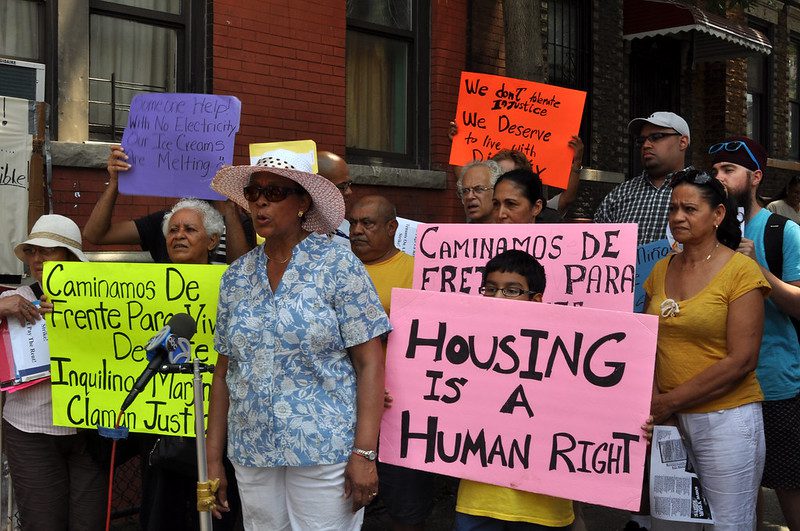
Photo by Flickr user Michael Fleshman, CC BY-SA 2.0
While the Constitution of the United States ensures citizens many rights, housing is not one of them, although such a right has been advocated for many years. Shelterforce asked Chester Hartman and Rachel G. Bratt (co-editors of A Right To Housing, with Michael E. Stone) to discuss this notion of a “right to housing.” Hartman, answering a series of questions, puts it into the context of other rights Americans expect.
The concept and reality of rights is, of course, an evolving drama, one that has played out in our nation’s history. The right of slaves to be free of bondage was won via armed struggle and political action that produced amendments to our Constitution. The right of women to vote has a similar, albeit less violent, history. Workers won the right to organize, a right that was codified by federal legislation. The Civil Rights movement produced a set of legal rights that did not previously exist and changed profoundly public culture and practices with regard to race.
Common to this evolution of rights was an appeal to this nation’s higher sense of justice, to the fundamental principles of democracy and to the protections embodied in the foundational documents of this country. Also common was political struggle, buttressed by intellectual support.
Entitlements, on the other hand, is a somewhat different, albeit related concept, having more to do with specific programs, such as Social Security, the Earned Income Tax Credit, food stamps, Medicaid/Medicare, school breakfasts and lunches, Supplementary Security Income and, of course, free K-12 public education.
How have housing rights evolved in the United States?
Some specific, although quite limited, rights/entitlements exist in the housing area. Local housing codes (varying enormously with respect to coverage and standards) provide something of a right to decent physical conditions. But enforcement is a problem and market realities limit the benefits these regulations offer.
A warranty of habitability and rent-withholding provisions exist in some jurisdictions. While this levels the playing field somewhat between landlord and tenant, it falls short of guaranteeing decent housing conditions and, as is true of housing codes, does not deal with the key issue of affordability. In those few areas that still have rent control, limits are placed on rent increases.
Federal, state and local laws bar discrimination on the basis of race, ethnicity, disability and other personal characteristics, as well as source of income. But again, enforcement is far less than ideal, and more subtle forms of residential discrimination are hard to detect and prove.
Due process must be followed in eviction and foreclosure proceedings. Relatedly, some jurisdictions provide protection to tenants against condominium conversions and demolitions. In a few areas, “just (good) cause” eviction statutes limit eviction to stipulated reasons.

Tenants in public and Section 8 housing are required to pay no more than 30 percent of their income as rent. In a few areas, by statute or litigation, homeless persons have a right to shelter (not to be confused with housing), and for the homeless there also exists, again in just a few areas, what might be labeled “a right not to freeze to death”: ordinances requiring that public buildings be opened to homeless persons when the temperature dips below a certain level.
And, as is constantly pointed out by low-income housing advocates, while there is no entitlement to a Section 8 certificate or a public housing unit, all homeowners are entitled to the most massive, albeit indirect, housing subsidy of all—the ability to deduct every dollar paid in property taxes and virtually all dollars paid in mortgage interest from their taxable income base, providing a huge and highly regressive housing subsidy to those who need it least. (Other provisions of our tax laws as they affect homeowners add to this disparity.)
So, our society has lots of rights and entitlements, with some limited kinds of rights in the housing area, but we’re way shy of a right to decent, affordable housing for all.
What steps have been taken to provide decent, affordable housing?
The nation has, of course, made great progress in the housing area—one would be foolish not to recognize the reduction, for example, in slum housing and severe overcrowding over the past few decades. However, affordability problems have risen and now occupy first place in that sad contest. And the elimination or destruction of poor housing, via the urban renewal/highway programs and private market forces, has been achieved at the cost of massive disruption in people’s lives and the growing gap between what people can afford to pay and the availability of housing units within their means.
In the Preamble to the 1949 Housing Act, Congress asserted the National Housing Goal, which called for “the implementation as soon as feasible of a decent home and a suitable living environment for every American family.” (Affordability was not mentioned, as slum housing conditions were the nation’s primary, most visible housing problem in the post-war period.) That goal was reiterated in the 1968 Housing Act, and in slightly different versions in the 1974 and 1990 Housing Acts.
Congress has never followed up with the programs or provided resources to attain that goal. Nor have statutory declarations provided the basis for litigation to compel allocation of the needed resources. The 1968 Act took the brave step of setting forth a 10-year numerical target—26 million units (6 million of which were for low- and moderate-income households)—and mandating year-by-year progress reports. But the effort failed by a considerable margin, and never again was Congress foolish enough to risk such embarrassment.
By contrast, in the health and education areas, the nation has at least set specific goals and timetables—a good first step. In the mid-1990s the U.S. Department of Health and Human Services laid out specific health objectives to be achieved by the end of the century. After reporting some progress, the Department launched “Healthy People 2010,” with updated goals. In the education area, Congress in 1994 passed the Goals 2000: Educate America Act, which identified eight national educational goals pertaining to school readiness and completion, student achievement and citizenship, teacher education and professional development, and parental participation. It also called for the high school graduation rate to increase to at least 90 percent by the year 2000, a dramatic reduction in the dropout rate and the elimination of the gaps in high school graduation rates between students from minority backgrounds and their non-minority counterparts. And of course, more recently, the No Child Left Behind Act, while controversial, has set specific goals in the education area.
Nothing even remotely comparable exists in the area of housing, save a commitment by some states and localities to 10-year plans to end homelessness—a worthy goal, to be sure, but light years away from a Right to Decent, Affordable Housing.
Why should we have such a right?
The arguments for a Right to Housing are straightforward: Housing is where people spend the most time, where family life is nurtured, so it should be safe, comfortable, supportive. Housing costs are, for most households, the largest expenditure and so should not be so high as to prevent meeting other basic needs—food, clothing, medical care, transportation, etc.
Housing is more than four walls and a roof: it is part of a neighborhood and community, providing opportunities for positive social interaction and safety from crime. Housing location affects access to quality schools, jobs and community services.
The societal costs—added health services to deal with housing-linked problems such as asthma, lead poisoning, rat bites, asphyxiation, communicable diseases; emergency fire and police services; crime and incarceration; services for the homeless; and so on—of not having decent, affordable housing for all are enormous and growing. A true cost-benefit analysis might show that not having a Right to Housing is far more costly, in economic terms alone, than not implementing such a right.
There is a great deal of support for having a Right to Housing. The U.S. Catholic Bishops, the Massachusetts Episcopal Diocese, and the American Baptist Churches are a few of the faith-based sources. The National Association of Social Workers is representative of support from relevant professional groups. Many United Nations documents, as well as the laws of a great many other countries, advocate for and assert such a right. There is no shortage of authoritative, compelling pleadings.
What would be the first step in creating a Right to Housing?
Were we to accept, politically, the need to establish a Right to Housing, we then would have to fill in the details as to the content of that right. While we’re not at that point, and all our energies should focus on achieving the principle and acceptance that there should be a Right to Housing, it is useful at least to list what elements need to be considered.
-
- Affordability standards. Rather than the usual percentage-of-income rule, Michael Stone, the late Cushing Dolbeare and others have put forward an approach that should be the operating principle – ensuring that all non-shelter needs, in addition to housing costs, can be met, thus producing a percentage figure that is not a fixed number but a variable according to household size and income level.
- Physical condition and space standards. The best local housing code standards (following a detailed examination of these ordinances) might be posited, or possibly HUD’s Housing Quality Standards. Overcrowding standards must guard, on the one hand, against cultural bias and, on the other hand, against accepting dramatically lower standards for the poor.
- A suitable living environment. With regard to the super-important issue of neighborhood quality, there are few, if any, usable standards at present, and so serious work must be undertaken to develop these. And security of tenure should be a key element, too, while allowing for reasonable land-use changes.
Why has the issue been ignored?
I would suggest several reasons for non-attention. One is that, to a large extent, the fact that one-third of the nation still is ill-housed is a hidden problem. Lack of affordability—our number-one problem—and its broader implications for poor people’s lives is not something the fortunate among us experience or even know about. Spatially, too, the rise of gated communities, sprawl and the extreme residential segregation by class and race keep those on top from knowing much about those on the bottom—a form of “American Apartheid,” as Douglas Massey and Nancy Denton’s 1993 study so aptly put it.
Race is its own barrier. The creation of a true Right to Housing bumps squarely against issues of location and access. Who is to live near whom, go to school with whom? Americans simply don’t want to acknowledge the workings and vast impact of structural racism, let alone individual racist attitudes and behavior. How to deal with that confounds us. But unless and until we face that problem, it will inhibit serious movement toward providing all Americans—Black, brown, yellow, white and all the skin color mixtures in between—with this basic need and right.
Cost is possibly another barrier. To provide every American household with decent, affordable housing, given the large and widening gap between incomes and housing costs, will require vastly more government subsidies than we now devote to housing—the exact amount of course depends on what kinds of programs, what systems of financing, ownership, development and management we choose (the more market-oriented, the larger the cost; the more we create a social housing sector, the smaller the cost), but think along the lines of $80-100 billion annually. Maybe it would be an easier sell if we make clear the costs of having one-third of a nation ill-housed—and explain how eliminating those costs greatly reduces the bill. And it may be an easier sell if we drive home the point that upper-income taxpayers already get subsidies of that order via the tax system. Not that the society can’t afford this: look how easily we come up with similar amounts to bail out savings and loans, make war, give massive tax breaks to the wealthy. It’s all a matter of political will.
So how do we get from here to there; how is that political will created?
No simple, quick answers here, but a few ending thoughts.
We need to make politicians and candidates—for local, state and federal offices—speak to the housing problem and commit to effective ameliorative programs. And that in turn requires grassroots pressure.
We need to emphasize housing’s links to problems in the areas of health, education, income support, food, crime, employment, immigration, economic and community development. In doing so, we will create coalitions of social justice activists whose power will grow exponentially.
Selective litigation may help as well. There are examples of social justice gains via lawsuits in other areas—ending legally sanctioned segregation in public schools, abolishing the poll tax, requiring due process hearings before government aid is terminated, facilitating receipt of welfare support by eliminating barriers based on interstate movement. The housing area is ripe for similar approaches, building on similar legal theories and laws governing public benefits, child welfare, mental health and other programs.
We won’t have a conservative/reactionary national administration forever, and the Congressional election results (in particular, having Maxine Waters as the incoming chair of the House subcommittee that deals with housing matters, and Jack Reed or Chuck Schumer as her Senate counterpart) are a hopeful sign. It’s time to think seriously about mounting a public and political campaign to make decent, affordable housing a right for all Americans.
This article is adapted from one that appeared in National Perspectives on Housing Rights (Scott Leckie, ed., Martinus Nijhoff Publishers, 2003) and is based on Hartman’s chapter in The Right to Housing: Foundation for A New Social Agenda (Temple University Press, 2006), which he co-edited with Rachel G. Bratt and Michael E. Stone.
About the Author


what is your source for the avg. 90 billion a year spent on public housing?